 vetvision.contact@gmail.com
 0789479268


KHÓA ĐÀO TẠO SIÊU ÂM CẤP CỨU Ổ BỤNG (AFAST) VÀ THEO DÕI SỰ SÔNG TRÊN MONITOR II ĐẠI HỌC CẦN THƠ, 17-18/09/2026

Trong cấp cứu thú y, khả năng đánh giá nhanh tình trạng bệnh thú, nhận diện những dấu hiệu bất thường và theo dõi sát các chỉ số sinh tồn đóng vai trò quan trọng trong quá trình đưa ra quyết định lâm sàng. Đặc biệt, đối với những bệnh thú có tình trạng diễn tiến nhanh, việc kết hợp siêu âm cấp cứu ổ bụng (AFAST) và theo dõi các thông số sinh tồn trên Monitor giúp bác sĩ thú y có thêm cơ sở đánh giá tình trạng bệnh thú và định hướng xử trí phù hợp.
Với định hướng đồng hành cùng đội ngũ bác sĩ thú y trong việc cập nhật kiến thức và nâng cao năng lực thực hành lâm sàng, Vet Vision đã tổ chức khóa học ngắn hạn “Siêu âm cấp cứu ổ bụng (AFAST) và theo dõi sự sống trên Monitor” trong hai ngày 17–18/09/2026 tại Đại học Cần Thơ.
Khóa học được xây dựng với tiêu chí xuyên suốt: Học đi đôi với thực hành – Bám sát lâm sàng – Lấy ca bệnh thực tế làm trọng tâm.

1. Siêu âm cấp cứu ổ bụng (AFAST) – Công cụ quan trọng trong đánh giá bệnh thú cấp cứu
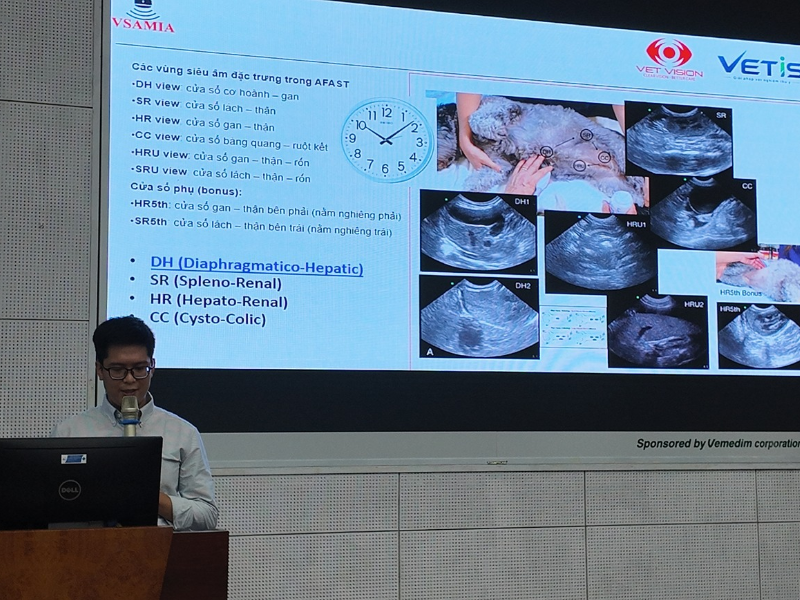
AFAST (Abdominal Focused Assessment with Sonography for Trauma) là kỹ thuật siêu âm tập trung đánh giá ổ bụng, thường được ứng dụng trong quy trình tiếp cận và đánh giá nhanh bệnh thú chấn thương hoặc có tình trạng cấp cứu.
Thông qua việc khảo sát các vị trí siêu âm trọng điểm, bác sĩ thú y có thể tìm kiếm các dấu hiệu gợi ý dịch tự do trong ổ bụng, hỗ trợ phát hiện những bất thường cần được quan tâm và đánh giá lại theo diễn tiến lâm sàng.
Tại khóa học, nội dung AFAST không chỉ dừng lại ở việc hướng dẫn các mặt cắt siêu âm mà còn tập trung vào những vấn đề có ý nghĩa thực tiễn:
-
Xác định và ghi nhớ các vị trí khảo sát AFAST.
-
Thực hiện đúng kỹ thuật đặt đầu dò và thu nhận hình ảnh siêu âm.
-
Nhận diện những dấu hiệu gợi ý dịch tự do trong ổ bụng.
-
Đánh giá hình ảnh trong mối tương quan với tình trạng lâm sàng của bệnh thú.
-
Nhận biết những hạn chế của AFAST và các tình huống cần kết hợp thêm phương pháp chẩn đoán khác.
-
Theo dõi sự thay đổi của các dấu hiệu siêu âm theo diễn tiến bệnh.
Đặc biệt, học viên được định hướng cách tiếp cận hình ảnh một cách có hệ thống, tránh việc chỉ ghi nhận hình ảnh đơn thuần mà không liên hệ với tình trạng huyết động và các biểu hiện lâm sàng của bệnh thú.
2. Theo dõi sự sống trên Monitor – Nâng cao khả năng đánh giá và kiểm soát bệnh thú cấp cứu
Trong quá trình cấp cứu, gây mê và hồi sức, theo dõi các chỉ số sinh tồn là một phần không thể thiếu nhằm đánh giá tình trạng bệnh thú và nhận diện sớm những thay đổi bất thường.
Monitor thú y cung cấp các thông số theo dõi quan trọng, hỗ trợ bác sĩ thú y đánh giá chức năng tim mạch, hô hấp và tình trạng oxy hóa của bệnh thú.
Khóa học tập trung vào việc giúp bác sĩ hiểu đúng ý nghĩa của từng thông số, biết cách thiết lập theo dõi và quan trọng hơn là diễn giải các chỉ số trong bối cảnh lâm sàng.
Các nội dung trọng tâm bao gồm:
-
ECG: Nhận biết hoạt động điện học của tim, đọc và đánh giá những bất thường về nhịp tim.
-
SpO₂: Theo dõi độ bão hòa oxy ngoại vi và nhận diện những yếu tố có thể ảnh hưởng đến độ tin cậy của phép đo.
-
ETCO₂: Đánh giá thông khí, theo dõi sự thay đổi CO₂ cuối thì thở ra và hỗ trợ nhận định tình trạng tuần hoàn trong những tình huống cấp cứu phù hợp.
-
NIBP: Theo dõi huyết áp không xâm lấn, lựa chọn kích thước vòng bít và vị trí đo phù hợp, nhận biết những yếu tố gây sai lệch kết quả.
-
Theo dõi các chỉ số sinh tồn: Kết hợp nhiều thông số để đánh giá tổng thể tình trạng bệnh thú thay vì nhận định từng chỉ số riêng lẻ.
Một trong những mục tiêu quan trọng của khóa học là giúp bác sĩ hiểu rằng giá trị của Monitor không chỉ nằm ở việc hiển thị các con số, mà còn ở khả năng phân tích, liên kết các thông số và nhận diện xu hướng thay đổi của bệnh thú để hỗ trợ đưa ra quyết định lâm sàng.
3. Học đi đôi với thực hành – Bám sát các tình huống cấp cứu thực tế
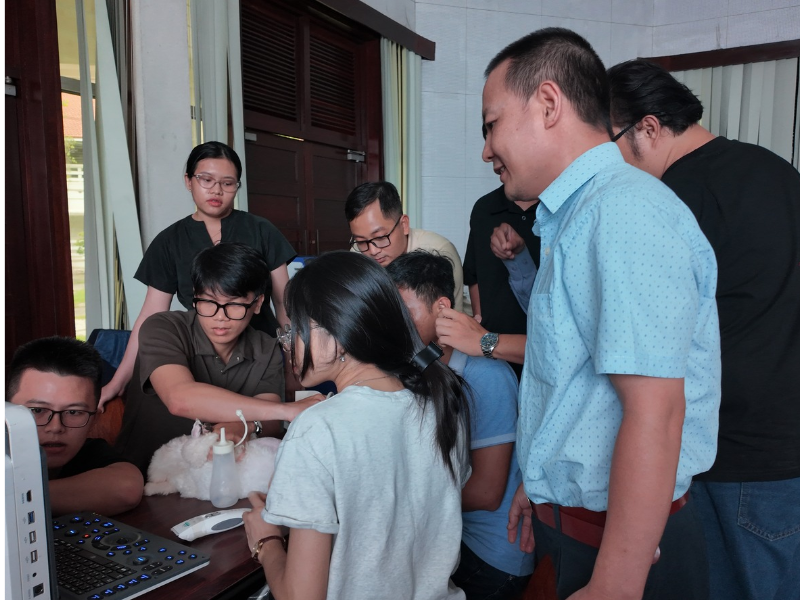
Điểm nhấn trong chương trình đào tạo của Vet Vision là định hướng kết hợp kiến thức lý thuyết với thực hành, lấy tính ứng dụng trong môi trường phòng khám và bệnh viện thú y làm trọng tâm.
Thay vì chỉ tiếp cận các kỹ thuật thông qua hình ảnh minh họa, học viên được định hướng thực hành thao tác trên thiết bị, quan sát hình ảnh siêu âm và theo dõi các thông số sinh tồn trên Monitor.
Thông qua quá trình học tập và trao đổi chuyên môn, các bác sĩ có cơ hội củng cố những kỹ năng quan trọng:
-
Thực hiện quy trình khảo sát AFAST một cách có hệ thống.
-
Nhận diện các dấu hiệu bất thường trên hình ảnh siêu âm.
-
Biết cách kiểm tra và đánh giá độ tin cậy của các thông số Monitor.
-
Nhận biết những sai sót kỹ thuật thường gặp trong quá trình đo và theo dõi.
-
Kết hợp dữ liệu siêu âm với các thông số sinh tồn để có cái nhìn toàn diện hơn về tình trạng bệnh thú.
-
Xác định những chỉ điểm cần lưu ý và các tình huống cần đánh giá lại hoặc can thiệp kịp thời.
Đặc biệt, việc phân tích các tình huống lâm sàng giúp học viên hiểu rõ hơn mối liên hệ giữa dấu hiệu hình ảnh, thông số theo dõi và biểu hiện thực tế của bệnh thú.
Đây cũng chính là định hướng đào tạo mà Vet Vision hướng đến: Không chỉ giúp bác sĩ biết cách sử dụng thiết bị, mà còn hiểu cách khai thác dữ liệu thiết bị để phục vụ quá trình chẩn đoán, theo dõi và điều trị.
4. Vet Vision – Đồng hành cùng bác sĩ thú y trong ứng dụng thiết bị hiện đại
Là đơn vị hoạt động trong lĩnh vực thiết bị thú y, Vet Vision không chỉ chú trọng cung cấp các giải pháp thiết bị phục vụ phòng khám và bệnh viện thú y mà còn hướng đến việc đồng hành cùng đội ngũ bác sĩ trong quá trình tiếp cận và ứng dụng công nghệ vào thực hành lâm sàng.
Thông qua các chương trình đào tạo chuyên môn, Vet Vision mong muốn tạo điều kiện để bác sĩ thú y:
-
Cập nhật kiến thức và kỹ thuật chuyên ngành.
-
Nâng cao khả năng thực hành siêu âm và theo dõi bệnh thú.
-
Hiểu rõ nguyên lý hoạt động và giá trị ứng dụng của các thiết bị.
-
Khai thác hiệu quả dữ liệu từ máy siêu âm và Monitor.
-
Từng bước chuẩn hóa quy trình theo dõi, đánh giá bệnh thú tại phòng khám và bệnh viện thú y.
Bên cạnh hoạt động đào tạo, Vet Vision cũng mang đến các giải pháp thiết bị thú y hiện đại, hỗ trợ bác sĩ xây dựng hệ thống chẩn đoán hình ảnh, theo dõi bệnh thú và hồi sức phù hợp với nhu cầu thực tế của từng cơ sở thú y.
Liên hệ Vet Vision để được tư vấn các giải pháp thiết bị siêu âm, Monitor theo dõi bệnh thú và thiết bị hồi sức chuyên dụng dành cho phòng khám, bệnh viện thú y.
In veterinary emergency medicine, the ability to rapidly assess a patient's condition, identify abnormal clinical signs, and closely monitor vital parameters plays an important role in clinical decision-making. Particularly in patients with rapidly progressing conditions, combining Abdominal Focused Assessment with Sonography for Trauma (AFAST) with vital parameter monitoring provides veterinarians with additional information to assess the patient's condition and guide appropriate clinical management.
With the aim of supporting veterinarians in updating their knowledge and enhancing their clinical skills, Vet Vision organized a short training course entitled “Abdominal Focused Assessment with Sonography for Trauma (AFAST) and Patient Monitoring” over two days, September 17–18, 2026, at Can Tho University.
The course was developed around three core principles: Combining Theory with Practical Training – Focusing on Clinical Application – Centering on Real Clinical Cases.
1. Abdominal Focused Assessment with Sonography for Trauma (AFAST) – An Important Tool in the Assessment of Emergency Patients
AFAST (Abdominal Focused Assessment with Sonography for Trauma) is a focused abdominal ultrasound technique commonly used as part of the initial approach and rapid assessment of trauma patients or patients presenting with emergency conditions.
By examining key ultrasound windows, veterinarians can identify findings suggestive of free abdominal fluid, helping detect abnormalities that require attention and reassessment according to the patient's clinical progression.
During the course, AFAST training went beyond teaching standard ultrasound views and focused on practical clinical applications, including:
-
Identifying and memorizing the key AFAST scanning windows.
-
Performing proper probe positioning and ultrasound image acquisition.
-
Recognizing findings suggestive of free abdominal fluid.
-
Interpreting ultrasound findings in correlation with the patient's clinical condition.
-
Understanding the limitations of AFAST and identifying situations where additional diagnostic methods are required.
-
Monitoring changes in ultrasound findings in relation to disease progression.
In particular, participants were guided in adopting a systematic approach to image interpretation, avoiding the practice of simply recording ultrasound findings without correlating them with the patient's hemodynamic status and clinical manifestations.
2. Patient Monitoring – Enhancing the Assessment and Management of Emergency Patients
During emergency care, anesthesia, and resuscitation, monitoring vital parameters is an essential component of patient assessment and early detection of abnormal changes.
Veterinary patient monitors provide important monitoring parameters that assist veterinarians in evaluating cardiovascular and respiratory function, as well as the patient's oxygenation status.
The course focused on helping veterinarians understand the clinical significance of each parameter, learn how to set up patient monitoring, and, more importantly, interpret the readings within their clinical context.
Key topics included:
-
ECG: Recognizing the heart's electrical activity, interpreting and assessing cardiac rhythm abnormalities.
-
SpO₂: Monitoring peripheral oxygen saturation and identifying factors that may affect measurement reliability.
-
ETCO₂: Assessing ventilation, monitoring changes in end-tidal carbon dioxide (ETCO₂), and supporting the evaluation of circulatory status in appropriate emergency situations.
-
NIBP: Monitoring non-invasive blood pressure, selecting the appropriate cuff size and measurement site, and recognizing factors that may lead to inaccurate readings.
-
Vital Parameter Monitoring: Integrating multiple parameters to assess the patient's overall condition rather than interpreting each parameter in isolation.
One of the key objectives of the course was to help veterinarians understand that the value of a patient monitor lies not only in displaying numerical readings, but also in the ability to analyze and correlate different parameters and identify trends in the patient's condition to support clinical decision-making.
3. Combining Theory with Practical Training – Focusing on Real Emergency Clinical Scenarios
A key feature of Vet Vision's training program is its emphasis on integrating theoretical knowledge with practical training, with a focus on clinical applicability in veterinary clinics and hospitals.
Rather than learning techniques solely through illustrative images, participants were guided through hands-on equipment operation, ultrasound image observation, and vital parameter monitoring using veterinary patient monitors.
Through learning activities and professional discussions, veterinarians had the opportunity to reinforce important clinical skills:
-
Performing a systematic AFAST examination.
-
Recognizing abnormal findings on ultrasound images.
-
Understanding how to check and assess the reliability of patient monitor readings.
-
Identifying common technical errors during measurement and monitoring.
-
Integrating ultrasound findings with vital parameters to gain a more comprehensive understanding of the patient's condition.
-
Identifying important clinical indicators and situations requiring reassessment or timely intervention.
In particular, the analysis of clinical scenarios helped participants better understand the relationship between imaging findings, monitoring parameters, and the patient's actual clinical presentation.
This is also the training philosophy that Vet Vision strives to promote: Not only helping veterinarians learn how to operate equipment, but also understand how to utilize the data generated by these devices to support diagnosis, patient monitoring, and treatment.
4. Vet Vision – Supporting Veterinarians in the Application of Modern Veterinary Equipment
As a company operating in the veterinary medical equipment sector, Vet Vision focuses not only on providing equipment solutions for veterinary clinics and hospitals but also on supporting veterinarians in accessing and applying technology in clinical practice.
Through professional training programs, Vet Vision aims to provide veterinarians with opportunities to:
-
Update their professional knowledge and techniques.
-
Enhance their practical skills in ultrasound and patient monitoring.
-
Understand the operating principles and clinical applications of medical equipment.
-
Effectively utilize data obtained from ultrasound machines and patient monitors.
-
Gradually standardize patient monitoring and assessment procedures in veterinary clinics and hospitals.
Alongside its training activities, Vet Vision also provides modern veterinary equipment solutions, supporting veterinarians in developing diagnostic imaging, patient monitoring, and resuscitation systems that meet the practical needs of each veterinary facility.
Contact Vet Vision for consultation on ultrasound equipment, veterinary patient monitoring systems, and specialized resuscitation equipment for veterinary clinics and hospitals.
